Where to stay
Where to stay in Rishikesh: the best areas
Tapovan for a working month, Upper Tapovan for quiet. Which bank, which bridges, rents and seasons.
Last updated 9 Oct 2026 · 13 min read
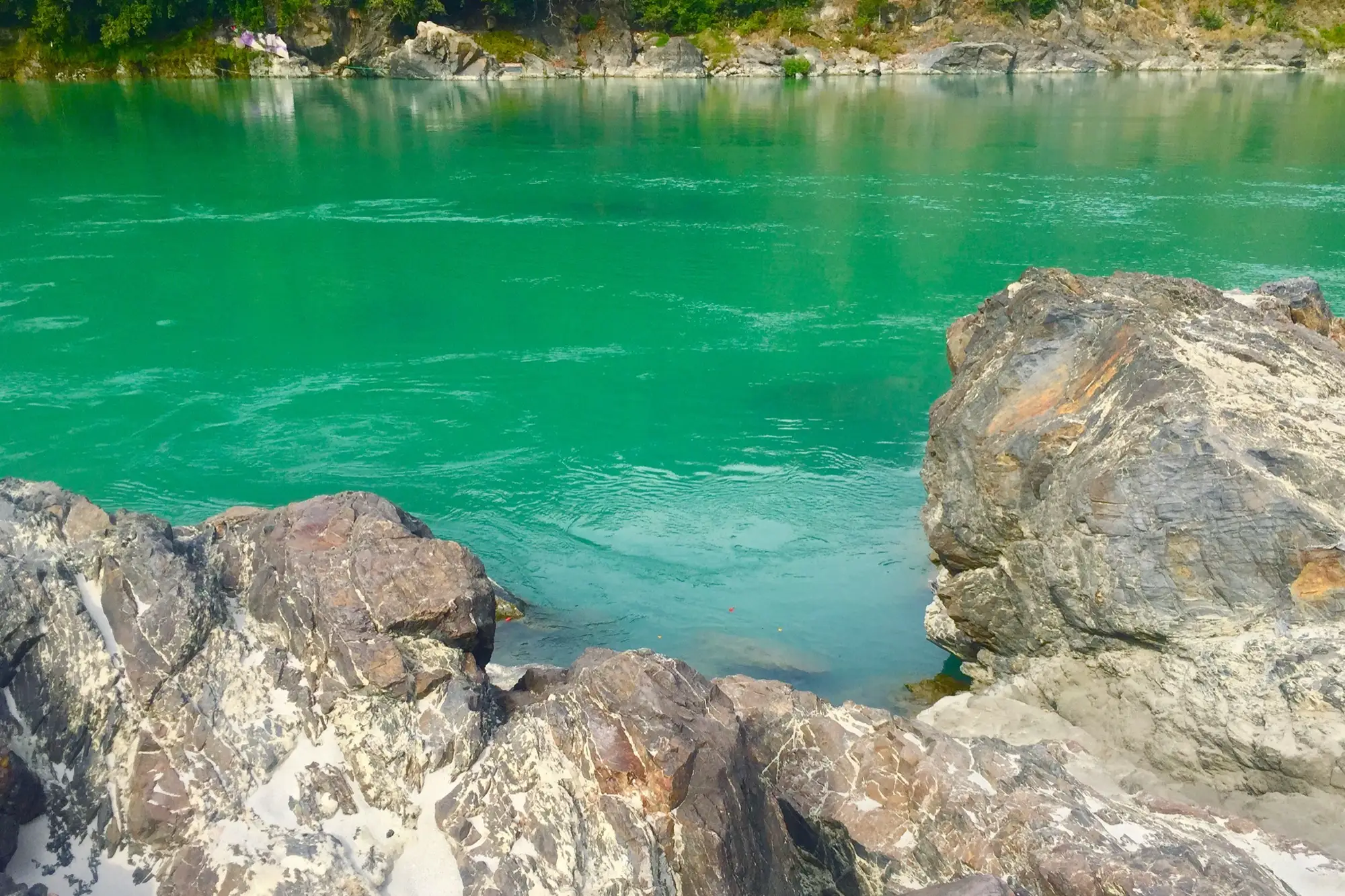
For a working week or month we'd pick Tapovan on the west bank, where autos and taxis reach the road and a furnished 1BHK asks ₹16,000 to ₹40,000 a month (median ₹31,000). Upper Tapovan is quieter but steep, and the main town suits anyone who wants a hospital and shops close. Swarg Ashram and the Jonk side of Laxman Jhula are on the east bank. Laxman Jhula is closed and Ram Jhula is shut until about December 2026, so a car reaches them only by the barrage road, 13.6 km from the bus stand.
On this page
- TL;DR summary
- Rishikesh areas compared
- Crossing the Ganga in Rishikesh
- Rent and room prices in Rishikesh by area
- Tapovan, Rishikesh
- Upper Tapovan
- Laxman Jhula and Jonk
- Ram Jhula and Swarg Ashram
- Main town and Triveni Ghat
- Shivpuri and the riverside upriver
- Tapovan vs Laxman Jhula
- Laxman Jhula vs Ram Jhula
- Where not to stay in Rishikesh, and why
- Rishikesh by season
- Homestay in Rishikesh
- Meat, eggs and alcohol in Rishikesh
- Form C for foreign guests staying in Rishikesh
- Best place to stay in Rishikesh for couples and families
- Frequently asked questions
This is one part of our Rishikesh guide.
TL;DR summary
- Tapovan from the bus stand: 5.7 km. About 9 minutes without traffic, and 7.6 km (about 10 minutes) from Yog Nagari station. Autos stop at the road head and the lanes are on foot.
- Tapovan rent: ₹16,000 to ₹40,000. A month for a furnished 1BHK, asking price. The median is ₹31,000.
- Ram Jhula: Closed. Shut to everyone since about 25 July 2026. Reopening is targeted for December 2026.
- Laxman Jhula: Closed since July 2019. Bajrang Setu beside it takes walkers. Cars go round by the barrage.
- East bank by road: 13.6 km. About 23 minutes from the bus stand via the barrage, without traffic.
- Meat, eggs and alcohol: Not sold. Banned inside the municipal limits. The strip from Tapovan to Swarg Ashram is dry in practice.
Rishikesh areas compared: best for, getting in, price band
| Area | Best for | Getting in | Price band | Keep in mind |
|---|---|---|---|---|
| Tapovan | A working month, cafes, yoga | 5.7 km, about 9 min from the bus stand. Autos stop at the road head, lanes on foot | ₹16,000 to ₹40,000 a month (furnished 1BHK, asking) | Horns, weekend crowds, stepped lanes |
| Upper Tapovan | Quiet, views, a scooter | 5.3 km, about 8 min. A car reaches some upper roads only | ₹14,000 to ₹25,000 a month | Steep and stepped, hard with bags |
| Laxman Jhula side (Jonk, east bank) | A short stay near the old temples | 13.6 km, about 23 min by road via the barrage, or on foot over Bajrang Setu | ₹10,000 to ₹25,000 a month | Loud rooms above the market; a crossing to reach Tapovan |
| Ram Jhula and Swarg Ashram | A week or two of ashram routine | 13.8 km, about 21 min via the barrage. Car-free lanes, Ram Jhula shut | Ashram rooms from a donation to ₹2,000 a night; few flats | Gates shut at night; very crowded in Kanwar Yatra |
| Main town and Triveni Ghat | Hospital, shops, local rent | 2.0 km, about 4 min from the bus stand. No bridge to cross | ₹15,000 to ₹29,000 a month (1 to 2BHK) | Few tourist rentals; ghat-level rooms flood in high water |
| Shivpuri and upriver | A short break by the river, with a car | 18 km, about 30 min. Vehicle only | ₹2,000 to ₹8,000 a night | No groceries or cafes; party camps on Friday and Saturday |
Where to stay in Rishikesh comes down to which bank of the Ganga you sleep on. Tapovan and the main town are on the west bank, where autos and taxis reach the road. Swarg Ashram and the Jonk side of Laxman Jhula are on the east bank, and with Laxman Jhula closed and Ram Jhula shut for repairs, a car gets there only by the barrage road, 13.6 km from the bus stand. No single area is best, but for a working week or month we’d start on the west bank.
The how to reach guide covers the way in.
Crossing the Ganga in Rishikesh: which bridges work in 2026
The bridges decide how easily you move between areas, and they change often. This is the position in late July and August 2026, so ask your host before you travel.
- Laxman Jhula: closed to everyone since July 2019.
- Bajrang Setu: the new bridge beside it. Walkers have used it since early 2026, and two-wheelers were on its deck by 30 July. It has not been formally inaugurated, and a ₹100 fee for the glass walkways was announced on 29 July with no start date.
- Ram Jhula: closed to everyone, walkers included, since about 25 July 2026. Reopening is targeted for December 2026, and these repairs have slipped before.
- Janki Setu: takes walkers and two-wheelers. With the boats from the Muni ki Reti ghat to the Swargashram ghat (daylight only, ₹30 to ₹50), it is the way across to the Swarg Ashram side for now.
- Luggage and cars: no car crosses the river at the jhulas. To reach the east bank with bags or a car, go by road over the barrage.
Rent and room prices in Rishikesh by area
A furnished 1BHK in Tapovan asks ₹16,000 to ₹40,000 a month, with a median of ₹31,000. Booked for 30 nights, a private room has a median near ₹31,000 and a whole place near ₹58,000. By the night, a dorm bed is ₹250 to ₹900 and a basic private room ₹500 to ₹2,500. Weekly rates vary by home, so ask the host for one. The cost of living guide covers the rest of the budget.
Tapovan, Rishikesh: best for a working month and cafes
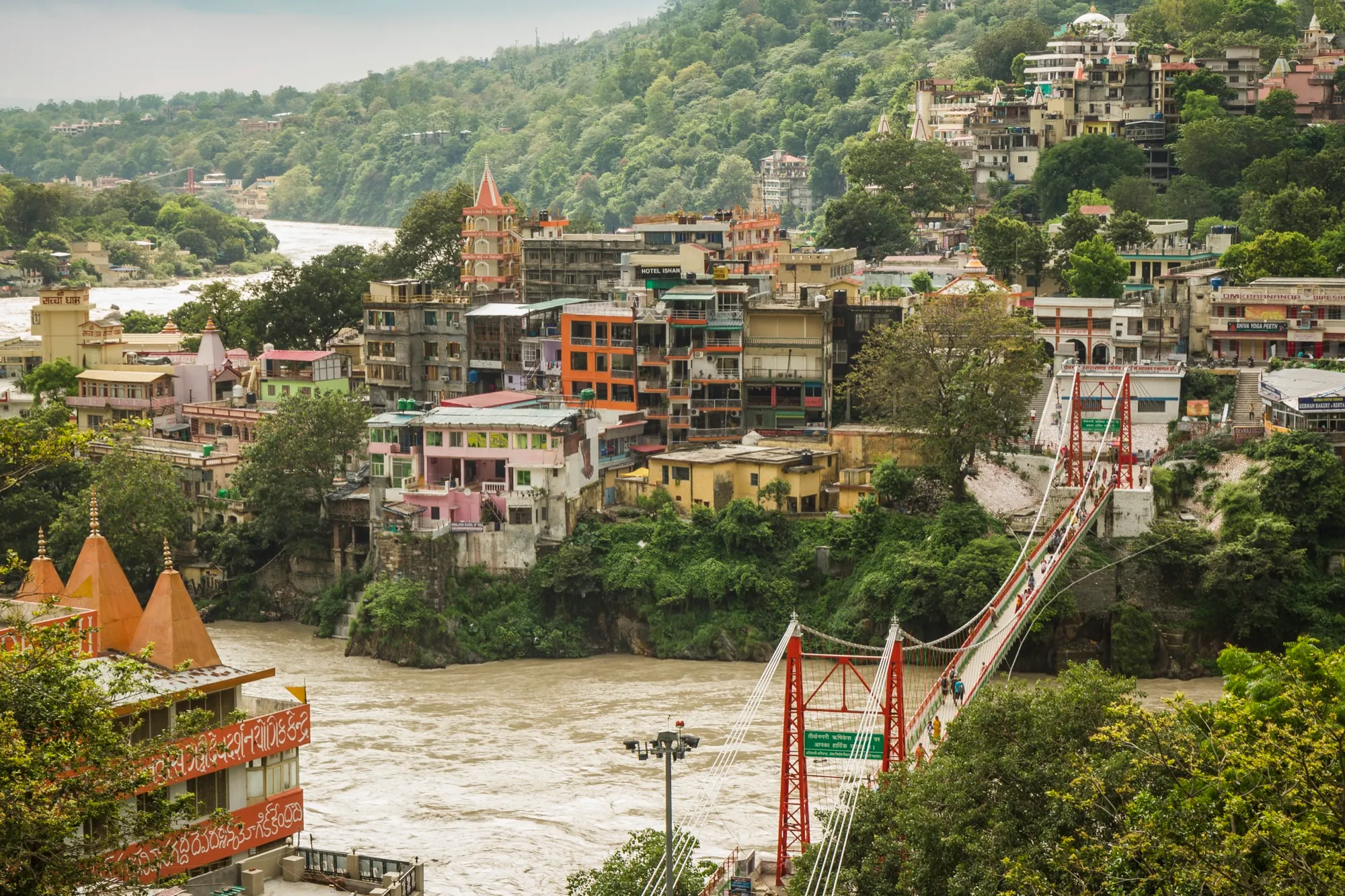
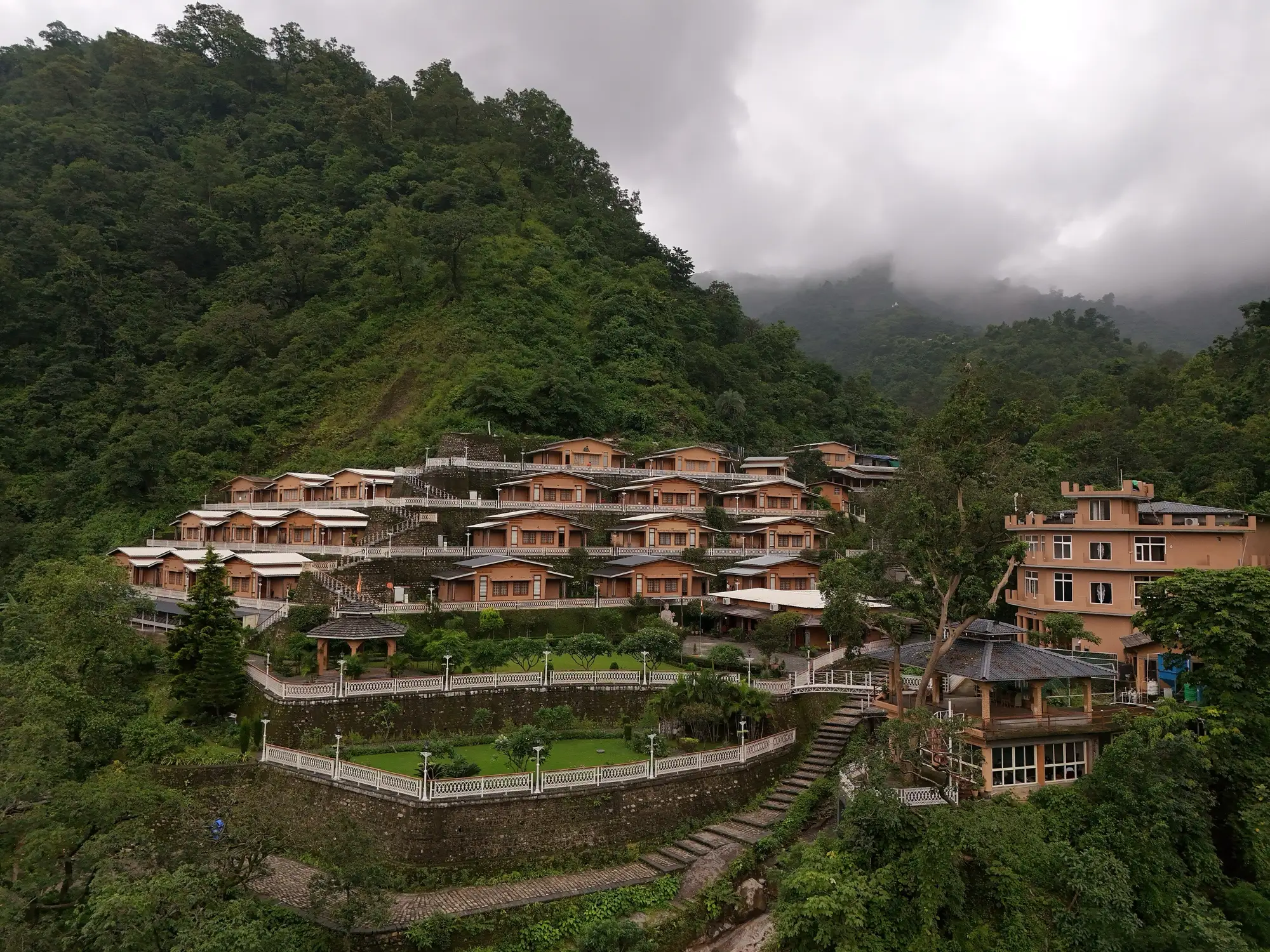 Much of Rishikesh is built up the hillside like this. Photo: Abhayaranya.yoga.ashram, CC BY-SA 4.0, via Wikimedia Commons.
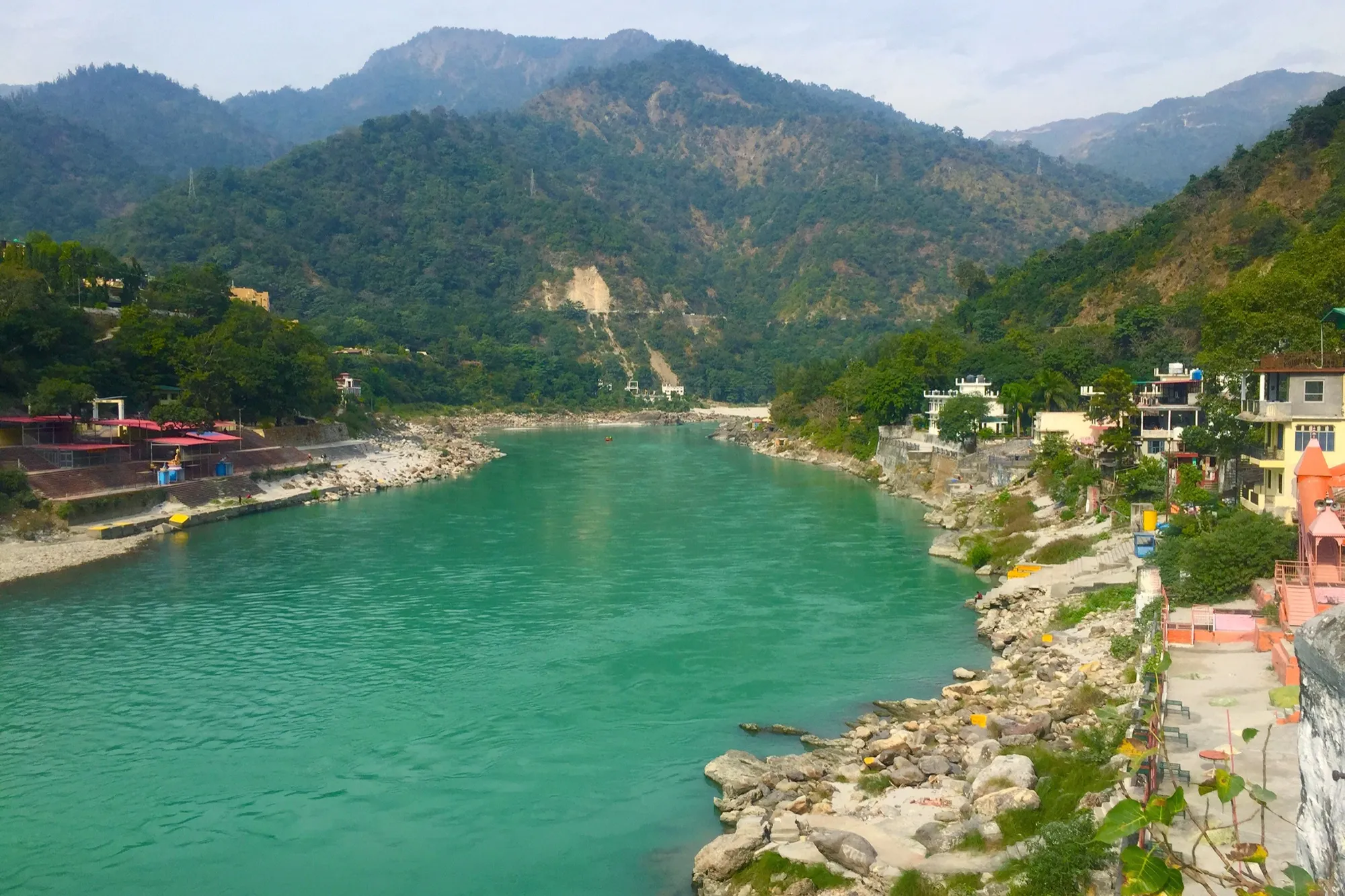
Tapovan is on the west bank, on the hillside around the old Laxman Jhula crossing, off the Badrinath road. It is the yoga and cafe quarter, a warren of narrow, stepped lanes not built for cars, and autos and taxis wait on the main road above. The lanes are 5.7 km from the bus stand, about 9 minutes without traffic. A private auto from town costs ₹150 to ₹300, though visitors are often quoted ₹500 to ₹700. Expect a short carry with bags at the end.
Evenings are lively. Scooter horns, live music at some hostels and weekend crowds are part of it, though the lanes quieten after 9 pm. The well-lit main roads are the comfortable way home late.
Many listings here are guesthouses rather than flats, so book two or three nights first, then walk the lanes asking for monthly rates. Homes here report anything from 8 Mbps to 200 Mbps, so get a dated speed test before you pay. Tapovan suits a first long stay, cafe work and yoga classes on foot. Skip it if you need silence or a step-free door.
Upper Tapovan: best for quiet and views, if you can manage the climb
Upper Tapovan is the hill above Tapovan on the same west bank, along Balaknath Road and the lanes above it. It is quieter and more residential, and 5.3 km from the bus stand, about 8 minutes without traffic. The cost is the slope: the Laxman Jhula crossing is about 8 minutes away on foot, steep and stepped. A car reaches the door on some of the upper roads but not in the lanes below, so ask which kind of address you are booking.
Scooters rent from about ₹500 a day and cost less by the month. Rent runs ₹14,000 to ₹25,000 a month, and internet follows the building, as in Tapovan. It suits people who work from the room and have a scooter. Skip it if you arrive late with heavy bags or need step-free access.
Laxman Jhula and Jonk: best for a short stay on the east bank
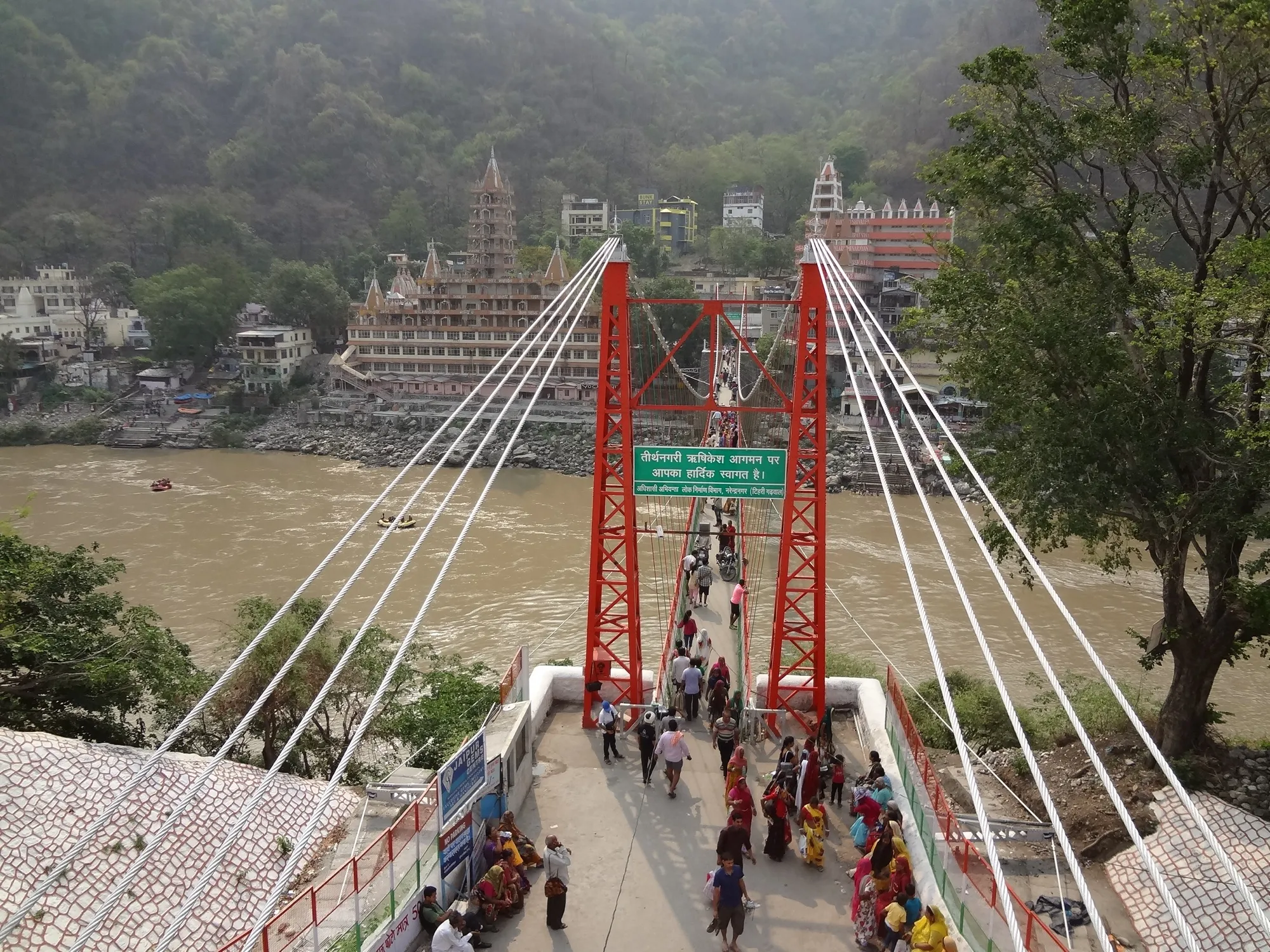 Laxman Jhula in 2016, before it was closed. Photo: Nilesh Keshri, CC BY-SA 4.0, via Wikimedia Commons.
Laxman Jhula names two places: the market lane at the Tapovan end on the west bank, and the east-bank side around Jonk village, which this section covers. With the old bridge closed, walkers cross on Bajrang Setu and a car goes round by the barrage road: 13.6 km and about 23 minutes from the bus stand, or 15.4 km from Yog Nagari station, without traffic. Crossing on foot with bags takes 10 to 20 minutes.
The bridgehead has a 13-storey temple and persistent hawkers. Rooms above the market stay loud well past dinner, and crowds spike in the Char Dham season. Jonk village sits back from the market and is quieter.
Monthly rents run ₹10,000 to ₹25,000. This side suits short stays and people who want the temple side of Rishikesh. Skip it if you will be on the Tapovan side every day, or arrive with heavy bags and no plan for the crossing.
Ram Jhula and Swarg Ashram: best for ashram stays, not for work
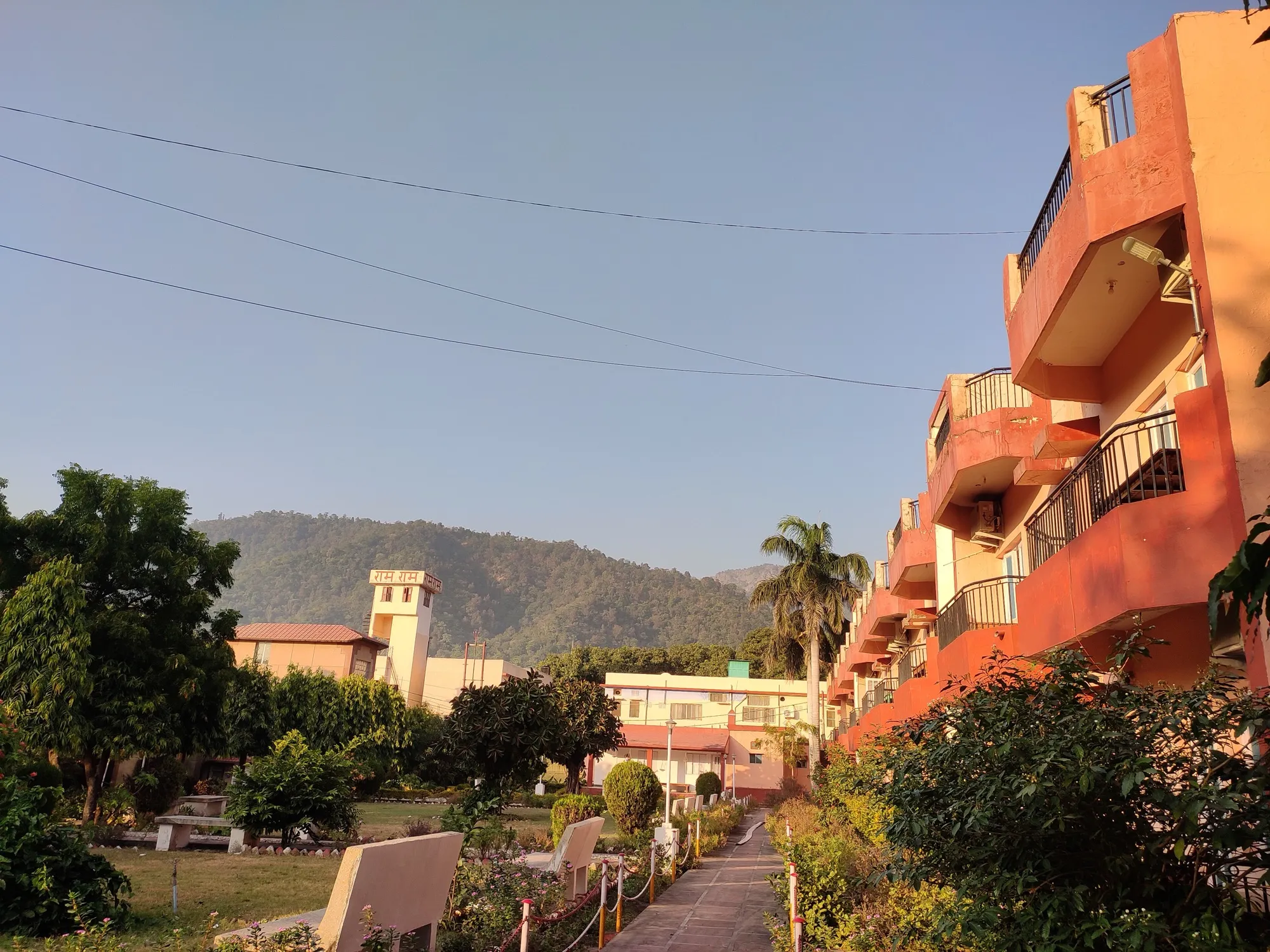 An ashram in Swarg Ashram. Photo: Goutam1962, CC BY-SA 4.0, via Wikimedia Commons.
Swarg Ashram is on the east bank, with Parmarth Niketan, Geeta Bhawan and the Swargashram Trust along a lane that is pedestrian-only. The west-bank gateway is Muni ki Reti, 2.9 km and about 5 minutes from the bus stand, with the main parking, Janki Setu and the boats. By road over the barrage, Swarg Ashram is 13.8 km and about 21 minutes from the bus stand.
Evenings follow the ashrams: the free Parmarth aarti around 6 pm, then bells and kirtan, and a lane that is quiet after 9 pm. The ashram gates shut at night. Geeta Bhawan has about 1,000 rooms, free or by donation, allotted in person. Swargashram Trust rooms start between ₹500 and ₹1,350 a night, and Parmarth rooms run ₹500 to ₹2,000 on a donation basis. Book Parmarth only through its own website, which never asks for payment by phone or WhatsApp.
Few private flats exist here, and monthly rents run ₹10,000 to ₹20,000. Carry cash, because the one SBI ATM can run dry at weekends. It suits a week or two of early mornings and low spending. We’d skip it for the first week of a working month, because no vehicle can reach the lanes, a bridge is still shut and few homes are on offer.
Main town and Triveni Ghat: best for hospitals, shops and local rent
The main town is on the west bank and takes in Ghat Road, Ganga Nagar, Indra Nagar, Palika Nagar and the AIIMS side. Triveni Ghat is 2.0 km and about 4 minutes from the bus stand, and 3.8 km from Yog Nagari station. No bridge lies between you and the bus stand or the railway station. AIIMS Rishikesh, with a 24-hour emergency department, is about 5 to 7 km from Tapovan and closer from here.
This is where local people live, with far fewer hotels and hostels. The ghat went under water in August 2023 and August 2025, so ask about the floor level of any room near the river.
A furnished 1BHK asks ₹15,000 to ₹17,000 and a 2BHK ₹17,000 to ₹29,000. It suits anyone with medical needs or a budget. Skip it if you want cafes and yoga at your door.
Shivpuri and the riverside upriver: best for a short break by the Ganga
Shivpuri is about 18 km upstream on the Badrinath highway, about 30 minutes without traffic and 30 to 45 in practice, and you need a vehicle. Camps sit set back from the water, so expect terraces rather than riverside sand. A camp bed is ₹999 to ₹5,000 a person, riverside glamping ₹2,000 to ₹6,000, and a mid-range river-view hotel ₹3,000 to ₹8,000 a night.
Weekday evenings are quiet, and Friday and Saturday nights bring the party camps. Mobile signal gets patchy in the gorge, and food is mostly the camps’ own canteens. It suits couples and families with a car for a few nights, but not a working week or month. The river runs high and brown from July to September, and many river operations pause.
Tapovan vs Laxman Jhula: which side of the river to pick
Tapovan is on the west bank and Jonk, the Laxman Jhula side, is on the east. That one fact does most of the deciding. A taxi reaches the Tapovan road head in about 9 minutes from the bus stand, but takes about 23 minutes round by the barrage to Jonk, and on foot you cross Bajrang Setu. Tapovan has the larger share of the cafes, yoga schools and furnished flats, while Jonk is cheaper at ₹10,000 to ₹25,000 a month against ₹16,000 to ₹40,000.
For a working month we’d take Tapovan. We’d take the east bank for a short stay with light bags, or if the old temples matter more than a daily walk to a cafe.
Laxman Jhula vs Ram Jhula: cafes and yoga or aarti and ashrams
The two bridges are about 2 km apart. Laxman Jhula, with Tapovan behind it, means cafes, yoga classes and the most homes to rent. Ram Jhula and Swarg Ashram mean ashrams, the Parmarth aarti and car-free lanes. For work, take the Laxman Jhula side. For a week of early mornings and routine, take Swarg Ashram.
Where not to stay in Rishikesh, and why
- Swarg Ashram for your first week of work. Cars do not reach the lanes, Ram Jhula is shut and few flats exist.
- An east-bank room when you arrive with heavy bags and no plan for the crossing. You either carry them over Bajrang Setu or ride 13.6 km round by the barrage.
- The Neelkanth road. The temple is 26 to 32 km and 1 to 1.5 hours away, with long queues on Sawan Mondays. It is a day trip, not a base.
- Riverside camps in July and August, or Shivpuri on a Friday or Saturday. The river is high and many operations pause, and the party camps fill at weekends.
- A front room on the Badrinath road, or a room above the Laxman Jhula market. Both are loud.
- A home sold on a private path to a river beach. Five or more people drowned at restricted river beaches between May and September 2026.
Rishikesh by season: monsoon river, Kanwar Yatra, heat and winter
The easiest window for a working month is mid-October to late November, with 25 to 29 C days and almost no rain. The Diwali weekend on 7 to 9 November 2026 is the exception for crowds. The best time to visit guide has the full picture.
In the monsoon the Ganga crossed the warning level at Rishikesh on 6 August 2026. On 5 and 6 August 2025 it touched the Shiva statue at the Parmarth aarti platform and Triveni Ghat went under. Hillside lanes sit above the river, and rooms at ghat level are the ones to question. Rafting closes on 30 June and has restarted between 23 and 27 September in recent years.
Kanwar Yatra falls in late July. In 2026 it ran from 30 July to 11 August, with all vehicles banned on the Delhi to Haridwar highway from 4 to 12 August, and Muni ki Reti and Swarg Ashram were the most crowded. In 2027 Sawan Shivratri is on 31 July, so expect the last days of July.
In summer the weather department’s averages for the nearest stations, Dehradun and Roorkee, put afternoons at 32 to 38 C from April to June, so a room without AC or a cooler is a poor bet. In winter, Dehradun nights average 6 to 8 C in December and January and many rooms have no heater. New Year week is the busiest. In March 2027 the Yoga Festival (9 to 15 March) and the Haridwar Ardh Kumbh bathing days (6 and 8 March) overlap, so book early.
Homestay in Rishikesh: what to ask a host before a week or a month
People searching for a homestay in Rishikesh usually mean a private home or room with a host nearby, which is what we list as homes and rooms. Whatever it is called, ask these before you pay.
- Internet: wired or mobile? Ask for the provider and a speed test with its date. Short power cuts knock Wi-Fi offline, so carry a SIM from a second network.
- Backup power: on 19 September 2026 the state power utility declared an emergency, with cuts of 35 minutes to 15 hours depending on the consumer category. Ask what the inverter runs and for how long.
- Cooling and heating: AC or a cooler for April to October, and a heater for December and January.
- Stairs and the last stretch: does a car reach the door, and how many steps lie between the road head and the room?
- Noise: which windows face the road, a temple, a market or a cafe with live music.
- Which bridge you depend on: on the east bank, ask how guests cross today.
- Water and kitchen: a purifier or sealed bottles, and a gas stove or induction hob.
- Deposit: most listings ask one month’s rent, and one Laxman Jhula listing asked for two. Get the terms in writing.
Meat, eggs and alcohol in Rishikesh: what the rule means by area
Selling meat, fish and eggs is banned inside the municipal limits of Rishikesh and Muni ki Reti, under a 1956 notification that the Supreme Court upheld in 2004. Liquor is banned across the Rishikesh municipal corporation area. The strip from Tapovan to Swarg Ashram, and the town, are vegetarian and dry in practice, and ashrams add their own rules inside their gates. Police act against public drinking: in 2026 five tourists were detained in Muni ki Reti after an assault on a parking attendant.
Shivpuri is out of town, so ask any camp or hotel upriver what it serves. In the town, don’t plan a stay around a beer or an egg. Our food and cafes guide shows what to eat instead.
Form C for foreign guests staying in Rishikesh
Anyone giving paid accommodation to a foreign guest, including a host renting an individual house, must file Form C with the Bureau of Immigration within 24 hours of arrival. Ask your host whether they file it before you pay.
Best place to stay in Rishikesh for couples and families: our picks
- Working month with cafes: Tapovan, with a dated speed test.
- Working month, quiet and fit: Upper Tapovan, with a scooter.
- Couples: Upper Tapovan on a road a car can use, or a Shivpuri hotel for a few nights.
- Families: a Shivpuri hotel for a short break, or the main town if a hospital and shops matter more.
- Solo women: Tapovan or the Laxman Jhula main-road side, on the lit roads after 9 pm.
- An ashram routine for a week or two: Swarg Ashram.
- A long stay on a budget: the main town.
The things to do guide covers each base.
Frequently asked questions about where to stay in Rishikesh
How far is Tapovan from the bus stand and Yog Nagari station?
The Tapovan lanes are about 5.7 km and 9 minutes from the bus stand, and 7.6 km and 10 minutes from Yog Nagari station, without traffic. Upper Tapovan is 5.3 km and 7.1 km. Autos and taxis stop at the road head, so the last stretch is on foot.
How far is Tapovan from Jolly Grant airport?
Jolly Grant, Dehradun's airport, is 20 to 25 km from Rishikesh and 40 to 45 minutes by taxi. A sedan costs ₹600 to ₹1,600 depending on whether you use the prepaid counter, so agree the fare before you get in.
Is Rishikesh safe at night?
The main roads in Tapovan and Laxman Jhula are well lit, the aarti crowd thins by about 7:30 pm and the lanes quieten after 9 pm. Avoid isolated riverbank paths, the roads behind the Tapovan hills and lonely ghats after dark. The emergency number is 112.
Is there a hospital near Tapovan?
AIIMS Rishikesh on Virbhadra Road has a 24-hour emergency department and is about 5 to 7 km from Tapovan. Its outpatient registration runs from 7:00 to 11:30 am, Monday to Saturday. For an ambulance call 108 or 112.
Do hostels in Rishikesh give discounts for long stays?
Many take 20 to 35 percent off for 14 days or longer. Ask for a monthly rate in writing, and check the dorm or private room is the one you will be given.
Can I rent a scooter to get around Tapovan and Upper Tapovan?
Rentals start around ₹500 a day for an Activa and cost less by the week or month. Bring your original driving licence and a government ID. Janki Setu takes two-wheelers, and the closed bridges do not.
More Rishikesh guides
 How to reachHow to reach Rishikesh from Delhi by bus, train, car or flightA daytime bus from Delhi takes 5 to 6 hours. Or take the Shatabdi to Haridwar, or fly to Dehradun.
 Things to doThings to do in Rishikesh: aarti, rafting and the shut bridgesAarti, rafting from ₹600, the Beatles Ashram and hill temples, with the shut bridges and the months to skip.
 TreksTreks near Rishikesh: waterfall walks, Neelkanth and bigger startsShort waterfall walks, Kunjapuri at sunrise, the Neelkanth walk, and Chopta or Kedarkantha as bigger starts.
 Food and cafesCafes in Rishikesh: food, prices and where to workCafes in Rishikesh by area, with what to eat, prices for two, opening times and laptop tips.
 Best time to visitBest time to visit Rishikesh for work, rafting, yoga and low pricesMid-October to late November for a working month. Rafting restarts in the last week of September.
 Cost of livingCost of living in Rishikesh: a week and a monthAbout ₹46,300 to ₹70,000 a month for a comfortable life. Frugal starts near ₹19,300.
 ItineraryRishikesh itinerary: 2, 3 and 5 days, and a monthTwo days in order, three and five as extensions, what fails by season, and four weekends.
Planning a week or a month in Rishikesh?
Tell us when you want to come and for how long. We'll reply with homes and rooms that fit.